Search-Supervised Deep Learning
Training and Deploying Neural Connect 4 Agents
A full-stack ML system that trains neural networks on MCTS self-play data and deploys them as real-time interactive bots via AWS Lightsail and Anvil. CNN and hybrid CNN-Transformer architectures achieve 81.7% Top-1 accuracy without tree search at inference.
- Project Focus
- Game AI, Supervised Learning, Cloud Deployment, Architecture Comparison
- Training Stack
- Python, TensorFlow/Keras, NumPy, MCTS, Google Colab
- Deployment
- AWS Lightsail, Docker, Anvil (Python web app)
- Dataset
- ~40,000 board states from 1,500 MCTS self-play games
System Architecture
This project was architected as a production-style ML pipeline rather than a standalone notebook. Clear separation of responsibilities mirrors real-world deployment patterns.
MCTS Self-Play → Dataset Generation → Model Training (Colab GPU)
→ Model Serialization (.h5)
→ Dockerized Inference API (AWS Lightsail)
→ Anvil Frontend (Authenticated UI)
→ Human vs Bot Gameplay
| Layer | Responsibility |
|---|---|
| Training | Model development and experimentation |
| AWS Backend | Stateless inference only |
| Docker | Environment reproducibility |
| Anvil Frontend | Authentication, UI, state management |
Data Generation
Rather than hand-labeling positions, MCTS was used as a high-quality move generator. The pipeline ran 1,500 self-play games with 1,200 rollouts per move over ~15 hours. Randomized early moves increased diversity; duplicate board states were consolidated via majority vote.
Model Results
| Metric | CNN | Hybrid Transformer |
|---|---|---|
| Top-1 Accuracy | 78.3% | 81.7% |
| Top-2 Accuracy | 92.4% | 94.1% |
| Inference Time | 1.2 ms | 3.8 ms |
| Training Time | ~20 min | ~2 hours |
| Best Use Case | Real-time, lightweight deployment | Maximum move prediction accuracy |
The hybrid model improves top-1 accuracy by 3.4 points. The CNN trades a small accuracy drop for 3x faster inference and 6x faster training, making it ideal for real-time deployment.
Architecture Journey
CNN: Iterative Refinement
Initial models exposed classic failure modes: shallow CNN underfit (~60%), deep CNN overfit, heavy regularization caused capacity collapse. The final CNN balanced depth and generalization with progressive convolution blocks (32 → 256 filters), batch normalization, dropout scheduling, and Global Average Pooling.
Pure Transformer
Performance plateaued at 46–55% accuracy. The 6×7 board is too small for effective token diversity, and transformers lack inductive spatial bias. Conclusion: transformers without feature extraction underperform on compact spatial domains.
Hybrid CNN–Transformer
CNN feature extractor compresses to 3×3 spatial tokens, then a 4-layer Transformer encoder and dense classification head. This combined spatial priors with global attention for the best overall accuracy.
Tactical Error Analysis
High Confidence (>95%)
- •Immediate wins: 98%+ accuracy
- •Forced defensive blocks
- •Opening central control
Failure Modes (<65%)
- •Multi-move traps
- •Dense endgames
- •Zugzwang states
Neural networks approximate pattern recognition but cannot simulate future branches. This reflects the historical evolution from supervised AlphaGo to AlphaZero-style policy + search hybrids.
Deployment
AWS Lightsail Backend
- •Dockerized TensorFlow inference service
- •Model loaded at startup, stateless requests
- •Returns probability distribution over 7 moves
- •Deterministic, low-latency inference (<4 ms)
Anvil Frontend
- •Authenticated UI (email/password, no auto signup)
- •Model selector (CNN vs Transformer)
- •Real-time human vs bot gameplay
- •Tab navigation: Play Game | Training Description
Anvil UI
The frontend was designed to resemble a polished consumer product: gradient background, rounded board container, elevated shadows, distinct yellow/red piece styling, animated feedback messages.
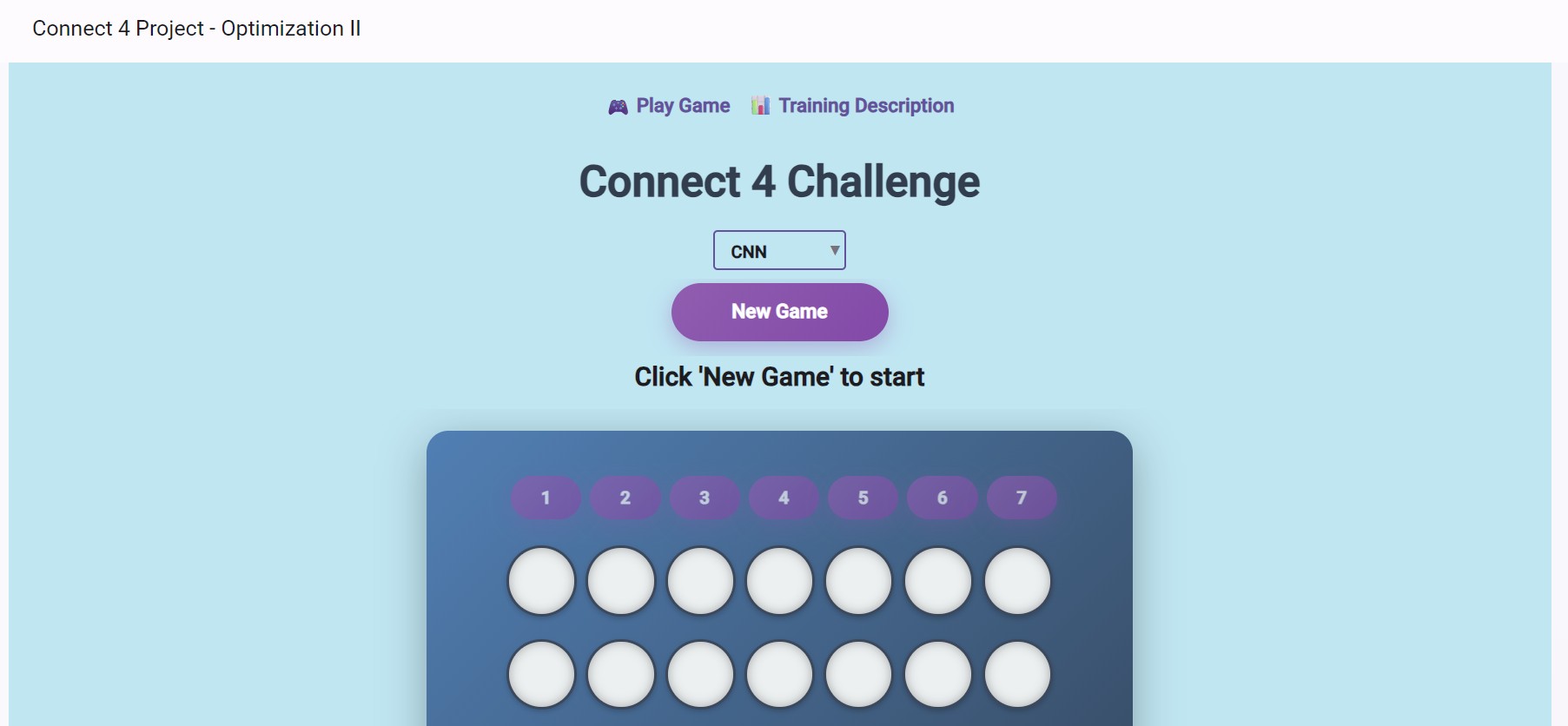
Game interface with model selector and board
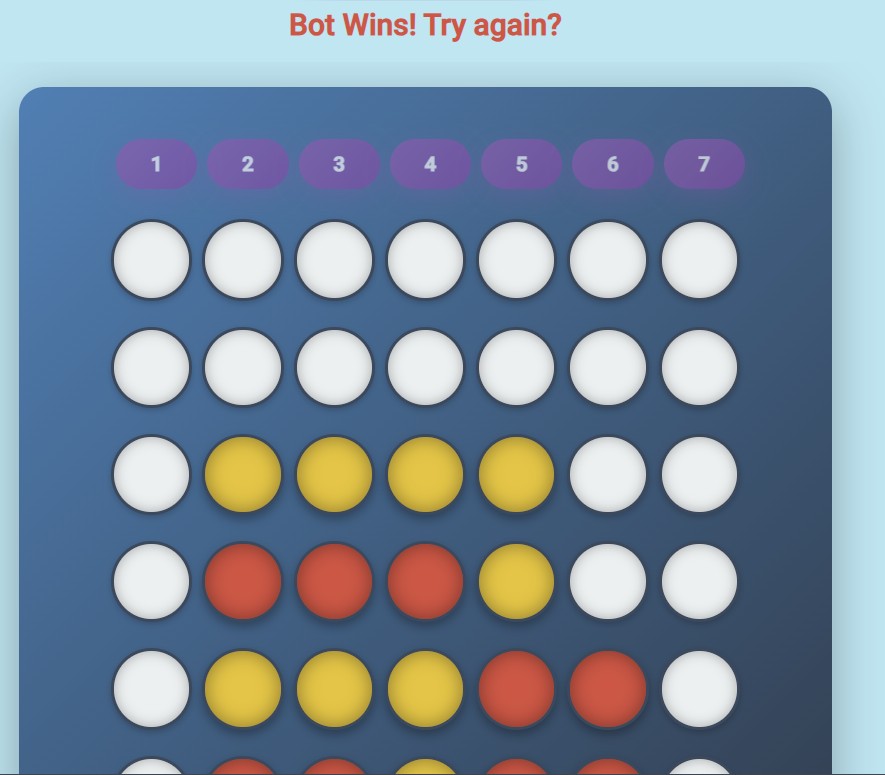
Interactive gameplay view
Model Performance Visualization
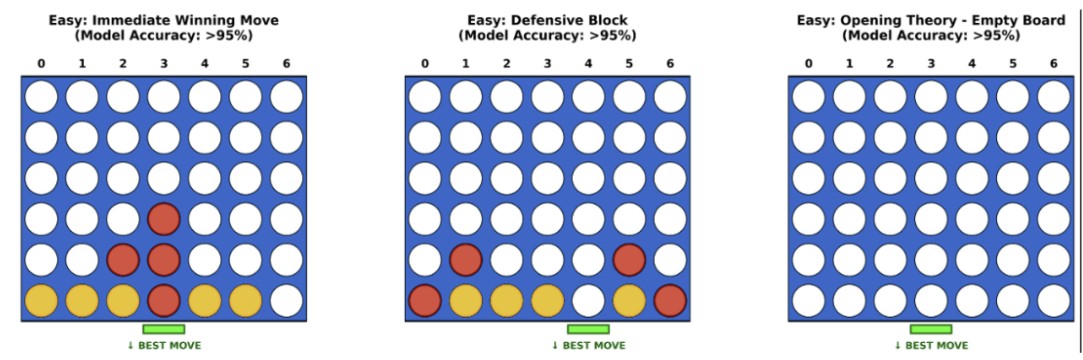
High-confidence board states where models excel
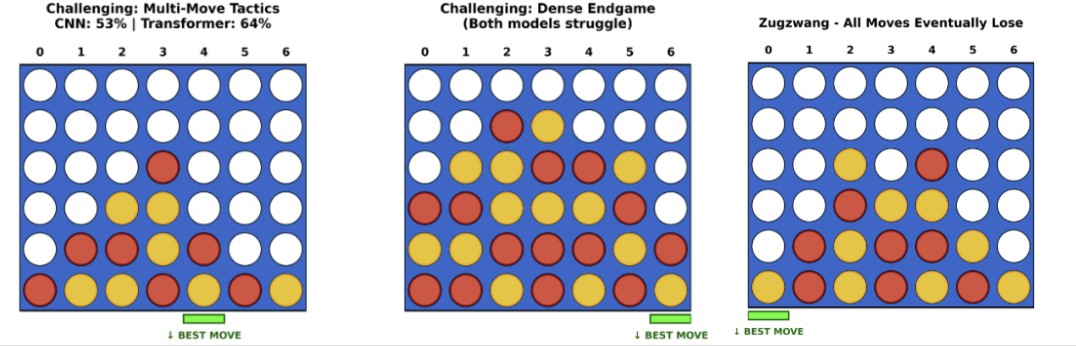
Challenging scenarios (multi-move traps, endgames)
Engineering Tradeoffs
| Dimension | CNN | Hybrid Transformer |
|---|---|---|
| Accuracy | Strong | Best |
| Latency | Excellent | Moderate |
| Training Cost | Low | High |
| Implementation Complexity | Moderate | High |
Both models were deployed to allow direct comparison in the live Anvil app.
Key Takeaways
- • Inductive bias matters more than model novelty; small spatial grids favor CNNs
- • Transformers benefit from hybridization with spatial feature extractors
- • Supervised imitation from MCTS labels has inherent planning limits; neural-guided search (AlphaZero-style) is the natural next step
- • Production deployment adds non-trivial engineering overhead: containerization, cloud hosting, authenticated UI
Future Improvements
Outcome
The final system achieves 81.7% Top-1 move prediction accuracy, avoids catastrophic tactical blunders, runs inference in under 4 ms, supports authenticated interactive gameplay, and is fully containerized and cloud-hosted. It reflects production-ready ML system design with measurable outcomes across search supervision, architecture experimentation, regularization tuning, Docker containerization, cloud deployment, and frontend integration.